The musical duo Perrey and Kingsley (Jean-Jacques Perrey (1929—2016) and Gershon Kingsley, (1922—2019), were pioneers in the field of electronic music. Prior to their collaboration in 1964, electronic music was considered to be purely avant-garde. They were among the first to create electronic music for the general public.
Kingsley was born in Germany. As his father was Jewish, his family fled the Deutsches Reich in 1938 to settle in Palestine-Land of Israel where the 15-year-old, self-taught musician began his career in music. After World War II, Kingsley emigrated to America where he became a pit conductor for Broadway musical shows after graduating from the Los Angeles Conservatory of Music.
Perrey was a French accordion player and medical student who abandoned his studies after meeting Georges Jenny in Paris in 1952. Jenny was the inventor of the Ondioline, a vacuum tube-powered keyboard instrument that was a forerunner of today's synthesizers and was capable of creating an amazing variety of sounds. Its keyboard had a unique feature — the keyboard was suspended on special springs that were capable of introducing a natural vibrato if the player moved the keyboard from side to side with the playing hand. The result was a beautiful, almost human-like vibrato that lent the Ondioline a wide range of expression. The keyboard was also pressure-sensitive, and the instrument had a knee volume lever as well. Jenny hired Perrey as a salesman and demonstrator of the new instrument. As a result, he came to the attention of French singer Édith Piaf, who sponsored him to record a demo tape that later facilitated him access to work and live in the United States between 1960 and 1970.
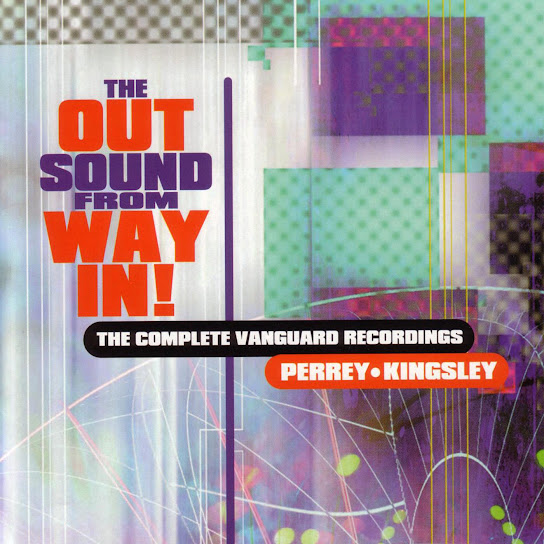
Perrey and Kingsley came together during Kingsley's stint as a staff arranger at Vanguard Records, an independent label in New York City that specialized not in avant-garde music, but in folk music. At that time, Perrey was experimenting with tape loops, which he had been introduced to by the French avant-garde musician Pierre Schaeffer. Each loop was a laboriously hand-spliced assemblage of filtered sounds, pitch-manipulated sounds and sometimes even animal calls. The end result of their first collaborative effort in 1966 combined Perrey's tape loops, and his inventive melodies with Kingsley's complementary arrangements and instrumentation. The resulting album was filled with tunes that sounded like music from an animated cartoon gone berserk. Their first LP was titled The In Sound From Way Out! and was released on Vanguard Records that same year. Since this was decades before the advent of widespread digital technology, each tune took weeks of painstaking editing and splicing to produce.
The twelve rather whimsical tracks bore names like "Unidentified Flying Object" and "The Little Man From Mars" in an attempt to make electronic music more accessible to the general public. In fact, "Unidentified Flying Object" and another of the album's cuts, "Electronic Can-Can" eventually became theme music for "Wonderama," a Metromedia Television children's program of the early 1970s. Though most of the melodies were original, two borrowed from the classics. "Swan's Splashdown" was based on Pyotr Tchaikovsky's "Dance of the Little Swans" while "Countdown At 6" borrowed from Amilcare Ponchielli's "Dance of the Hours," much as Allan Sherman did in 1963 with his hit recording, "Hello Muddah, Hello Fadduh." The final cut on the album, "Visa To The Stars" is co-credited to "Andy Badale," who would go on to fame as Angelo Badalamenti, arranger of the music in many of David Lynch's movies. In contrast to the rest of the album, "Visa To The Stars" is a more serious gesture and lacks the unusual sound effects of the other eleven cuts. It is highly reminiscent of the style of Joe Meek and his hit, "Telstar" by The Tornados. Perrey's Ondioline carries the melody throughout. This is also comparable to Kai Winding's 1963 recording of "More", which also carries the melody on the Ondioline.
Their second and final collaborative effort came in 1967 with the release of Kaleidoscopic Vibrations: Electronic Pop Music From Way Out, which was re-released in 1971 under the title: Kaleidoscopic Vibrations: Spotlight on the Moog. This was a similar sounding effort, but instead of all original compositions, the album was mostly versions of popular songs of the day. In this album, Perrey's tape loops and effects were added in post-production after Kingsley's orchestrations were recorded, a technique now commonly used by electronic artists to this day. The album was one of the first to use the new Moog modular synthesizer, a massive, complicated electronic instrument resembling an old-style telephone switchboard. The album also bore two notable singles. In fact, the Moog album was released a year and a half before the release of Wendy Carlos' ground-breaking Switched-On Bach. "The Savers" would go on to fame in 1968 as the Clio Award-winning music for a television ad for N