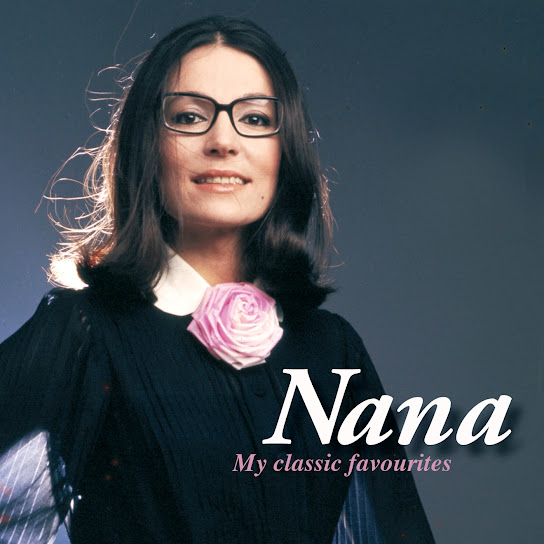
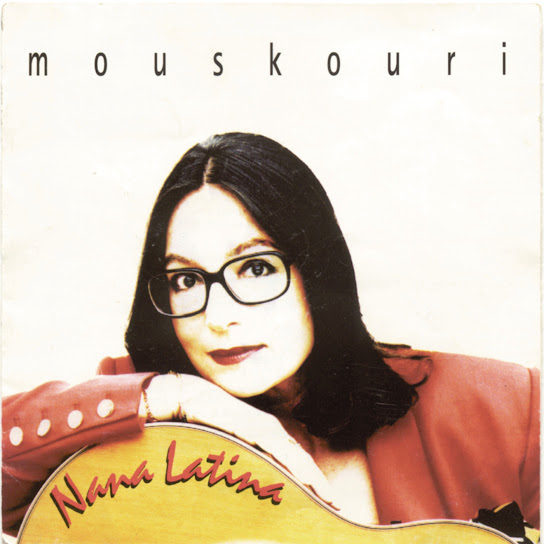
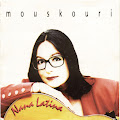
Nana Mouskouri (Greek: Νάνα Μούσχουρη, born Ioanna Mouskouri at October 13, 1934, in Chania, Crete, Greece) is a Greek singer and politician. She was known as Nana to her friends and family as a child. She is the world's highest-selling female recording artist, having sold over 300 million albums in fifteen languages, including Greek, French, English, Spanish, Italian, German, Latin, and Portuguese, over 450 albums. She is France's number one selling artist. She is noted for her trademark black-rimmed eyeglasses and her songs of melancholy, longing, and sentimental musings upon love, for which the emotion of her voice is exceptionally suited. Mouskouri has recorded from the 1960s into the new millennium. She has tailored releases to specific international markets with tremendous success, having acquired more than 230 gold and platinum albums worldwide.
Mouskouri's family lived in Canée, Crete, where her father, Constantin, worked as a film projectionist in a local cinema. Her mother, Alice also worked in the same local cinema as an usherette. When Mouskouri was three, Constantin moved the family to Athens. Mouskouri's family worked extremely hard in order to send Nana and her elder sister, Jenny, to the prestigious Athens Conservatoire. Mouskouri had displayed exceptional musical talent from the age of 6. However her sister, Jenny, appeared to be more the more gifted of the two. In fact Mouskouri only had one 'working' vocal chord (rather than the normal two). This a rare condition gives her voice its particularly original timbre.
Mouskouri's childhood was colored by the Nazi occupation of Greece. Her father became part of the Nazi resistance movement in Athens. Mouskouri began singing lessons at age 12. Despite the flaw in her vocal cords, Mouskouri took singing lessons regularly. During the Nazi German occupation, her family no longer had the financial means to pay for her singing lessons. But her teacher saw that she had a certain talent and continued to give her lessons free of charge. As a child, she listened to radio broadcasts of American jazz singers such as Frank Sinatra, Ella Fitzgerald, and Billie Holiday as well as French chanson stars like Edith Piaf.
In 1950, she was accepted at the Conservatoire. She studied classical music with an emphasis on singing opera. The young Mouskouri committed herself into classical music studies with a passion, perfecting her vocals with extraordinary self-discipline as well as taking piano and harmony classes. After 8 years at the Conservatoire, Mouskouri was encouraged by her friends to experiment with jazz music. She soon began singing with her friends' jazz group at night and they even managed to get a radio slot. However, when Mouskouri's Conservatory professor found out about Mouskouri's involvement with a genre of music that he considered to be absolutely worthless, he flew into a fury and prevented her from sitting her end of year exams. Consequently, the Conservatoire expelled her. Mouskouri's dreams of becoming an opera singer were dashed.
Mouskouri left the Conservatoire and began performing at the Zaki club in Athens. She began singing jazz in nightclubs with a bias on Ella Fitzgerald repertory. It was at the Zaki in 1958 that Mouskouri met the famous Greek composer Manos Hadjidakis. Hadjidakis was immensely impressed by Nana’s original voice and immediately offered to write songs for her. He became her mentor. In 1959 Mouskouri performed Hadjidakis' Kapou Iparchi Agapi Mou (co-written with poet Nikos Gatsos) at the inaugural Greek Song Festival. The song won first prize, and Mouskouri began to be noticed. At the 1960 Greek Song Festival, she performed two more Hadjidakis compositions, Timoria and Kiparissaki. Both these songs tied for first prize. Mouskouri soon ventured further and participated at the Mediterranean Song Festival, held in Barcelona where she performed Kostas Yannidis' composition Xypna Agapi Mou. The song won first prize. Her wins attracted interest from several international record companies. Mouskouri wound up signed a recording contract with the Paris-based Philips-Fontana axis.
In 1961, Mouskouri performed the soundtrack of a German documentary about Greece. This resulted in the German-language single Weisse Rosen aus Athen ("The White Rose of Athens"). The song was originally adapted from a folk melody by Hadjidakis. It became an enormous hit, selling over a million copies in Germany. The song was later translated into several different languages and it went on to become one of Mouskouri's signature tunes. Mouskouri married Yorgos Petsilas in 1961. Mouskouri and Petsilas have two children, son, Nicolas born in February 1968 and daughter, Hélène born in 1970. In 1974, Mouskouri and Petsilas separated and she moved to Geneva, Switzerland. In 1975, Mouskouri and Petsilas were officially divorced.
In 1962, she met renowned American song producer Quincy Jones. Jones got her to go to New York to record an album of American jazz ti