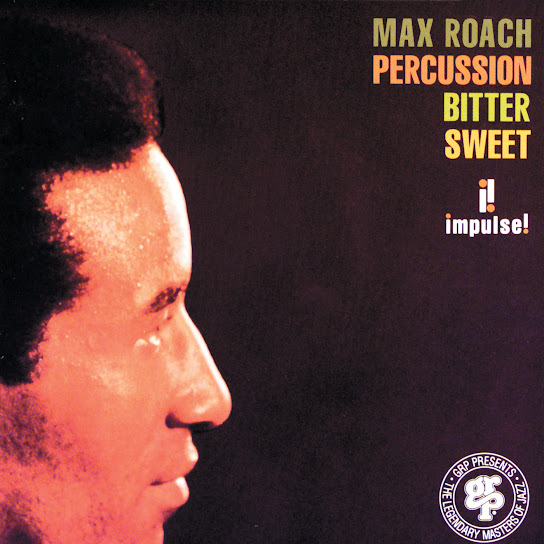
Maxwell Lemuel Roach (January 10, 1924 – August 16, 2007) was an American jazz drummer and composer.
A pioneer of bebop, Roach went on to work in many other styles of music, and is generally considered alongside the most important drummers in history. He worked with many famous jazz musicians, including Coleman Hawkins, Dizzy Gillespie, Charlie Parker, Miles Davis, Duke Ellington, Thelonious Monk, Charles Mingus, Billy Eckstine, Stan Getz, Sonny Rollins, Eric Dolphy and Booker Little. He was inducted into the Down Beat Hall of Fame in 1980 and the Modern Drummer Hall of Fame in 1992.
Roach also led his own groups, notably a pioneering quintet co-led with trumpeter Clifford Brown and the percussion ensemble M'Boom, and made numerous musical statements relating to the Civil Rights Movement.
Roach was born in the Township of Newland, Pasquotank County, North Carolina, which borders the southern edge of the Great Dismal Swamp, to Alphonse and Cressie Roach. Many confuse this with Newland Town in Avery County. Although Roach's birth certificate lists his date of birth as January 10, 1924, Roach has been quoted by Phil Schaap as having stated that his family believed he was born on January 8, 1925. Roach's family moved to the Bedford-Stuyvesant neighborhood of Brooklyn, New York when he was 4 years old. He grew up in a musical home, his mother being a gospel singer. He started to play bugle in parade orchestras at a young age. At the age of 10, he was already playing drums in some gospel bands. In 1942, as an eighteen-year-old fresh out of Boys High School, he was called to fill in for Sonny Greer with the Duke Ellington Orchestra when they were performing at the Paramount Theater.
In 1942, Roach started to go out in the jazz clubs of the 52nd Street and at 78th Street & Broadway for Georgie Jay's Taproom (playing with schoolmate Cecil Payne). His first professional recording took place in December 1943, supporting Coleman Hawkins.
Roach's most significant innovations came in the 1940s, when he and jazz drummer Kenny Clarke devised a new concept of musical time. By playing the beat-by-beat pulse of standard 4/4 time on the "ride" cymbal instead of on the thudding bass drum, Roach and Clarke developed a flexible, flowing rhythmic pattern that allowed soloists to play freely. The new approach also left space for the drummer to insert dramatic accents on the snare drum, "crash" cymbal and other components of the trap set.
By matching his rhythmic attack with a tune's melody, Roach brought a newfound subtlety of expression to his instrument. He often shifted the dynamic emphasis from one part of his drum kit to another within a single phrase, creating a sense of tonal color and rhythmic surprise. The idea was to shatter musical conventions and take full advantage of the drummer's unique position. "In no other society", Roach once observed, "do they have one person play with all four limbs."
While that approach is common today, when Clarke and Roach introduced the new style in the 1940s it was a revolutionary musical advance. "When Max Roach's first records with Charlie Parker were released by Savoy in 1945," jazz historian Burt Korall wrote in the Oxford Companion to Jazz, "drummers experienced awe and puzzlement and even fear." One of those awed drummers, Stan Levey, summed up Roach's importance: "I came to realize that, because of him, drumming no longer was just time, it was music."
He was one of the first drummers (along with Kenny Clarke) to play in the bebop style, and performed in bands led by Dizzy Gillespie, Charlie Parker, Thelonious Monk, Coleman Hawkins, Bud Powell, and Miles Davis. Roach played on many of Parker's most important records, including the Savoy November 1945 session, a turning point in recorded jazz.
In 1952 Roach co-founded Debut Records with bassist Charles Mingus. This label released a record of a concert, billed and widely considered as "the greatest concert ever," called "Jazz at Massey Hall," featuring Charlie Parker, Dizzy Gillespie, Bud Powell, Mingus and Roach. Also released on this label was the groundbreaking bass-and-drum free improvisation, "Percussion Discussion."
In 1954, he formed a quintet featuring trumpeter Clifford Brown, tenor saxophonist Harold Land, pianist Richie Powell (brother of Bud Powell), and bassist George Morrow, though Land left the following year and Sonny Rollins replaced him. The group was a prime example of the hard bop style also played by Art Blakey and Horace Silver. Tragically, this group was to be short-lived; Brown and Powell were killed in a car accident on the Pennsylvania Turnpike in June 1956. After Brown and Powell's deaths, Roach continued leading a similarly configured group, with Kenny Dorham (and later the short-lived Booker Little) on trumpet, George Coleman on tenor and pianist Ray Bryant. Roach expanded the standard form of hard-bop using 3/4 waltz rhythms and modality in 1957 with his album Jazz in 3/4 time. During this period