Golden Earring was a Dutch rock band from The Hague, active from 1961 to 2021. The internationally most succesful rock band to come out of the Netherlands, they had 47 chart hits in their home country. In North America they are best known for their brace of major hits, Radar Love (1973, an American hit in 1974) and Twilight Zone (1982, an American hit in 1983).
Formed in 1961, the band was active for 60 years, almost non-stop. They had 56 years of studio output, starting in 1965, until their tragic end on 5 February 2021, when guitarist founding member George Kooymans revealed that he had been diagnosed with the neuro-muscular disease, ALS.
The band's core line-up of four was unchanged from 1970 to 2021, although additional musicians had short stints in the band in the 1970s. Golden Earring was always touring, except in 2000 (their only sabbatical year) and the final year of their existence, due to the Covid-19 pandemic.
In 1961 George Kooymans (age 13) and his neighbour Rinus Gerritsen (age 15) formed The Tornado's in the Zuiderpark district of their home town of The Hague. The band's first line-up mainly played The Shadows and The Ventures covers, as well as other instrumental tunes, and played its first gigs at school parties.
In 1963, as the band found out that there already was a British band called The Tornados, they decided to change their name into The Golden Ear-rings (after a Peggy Lee song). Their debut single, 1965's Please Go, immediately landed in the Dutch Top 10.
Under the Golden Earrings moniker the band eventually recorded four albums and had twelve hit singles in the Netherlands between 1965 and 1969, ten of which reached the Dutch Top 10.
One of the band's sixties singles became their first Dutch #1 hit: 1968's somewhat carnavalesque Dong-Dong-Diki-Digi-Dong, although that tune is now frowned upon by the band and generally regarded as inferior to other Earrings singles of the era, such as That Day (1966), Sound Of The Screaming Day (1966) and the epic Just A Little Bit Of Peace In My Heart (1969).
The band's lead singer during the early Golden Earrings years was Frans Krassenburg. He was replaced by Barry Hay (of The Haigs) in 1967. The band's drummer for much of the 1960s was Jaap Eggermont. His successors were Sieb Warner (1969) and, in 1970, Cesar Zuiderwijk (ex-Livin' Blues), Golden Earring's definitive drummer.
The band's international career modestly started to take off in 1969, the year of their psychedelic Eight Miles High album, their first haphazard tour of the United States. The band slightly changed its name becoming Golden Earring. Their 19-minute cover version of The Byrds' classic Eight Miles High and the 1969 single, Another 45 Miles, were the first Golden Earring recordings to get some modest North American airplay.
The arrival of drummer, Cesar Zuiderwijk, in 1970, completed what would turn out to be the group's definitive line-up: Barry Hay (lead vocals/guitar/flute), George Kooymans (guitar/vocals), Cesar Zuiderwijk (drums) and Rinus Gerritsen (bass/harmonica/keyboards).
1970 saw a dramatic shift in Golden Earring's musical style. After the melodic sixties beat of The Golden Earrings and a brief phase of psychedelia and hippie rock in 1968 and 1969, the single Back Home marked the birth of Golden Earring's trademark heavy, riff-based brand of hard rock with catchy hooks. Back Home hit #1 in the Dutch charts and 'broke' Golden Earring in most of mainland Europe, notably countries such as Germany, Switzerland, Austria and France.
Between 1966 and 1976 seventeen consecutive Earring singles rocketed into the Dutch Top 10, while their international popularity increased, especially after their lengthy 1972 tour of Europe, supporting The Who. Buddy Joe (1972) achieved considerable chart success in the German-speaking countries of Europe, but 1973's Radar Love brought global stardom: #13 in the U.S. Billboard Hot 100, #1 in the U.S. Cashbox chart, #5 in Britain, #8 in Australia, #10 in Canada, #5 in Germany, #6 in Belgium, #1 in Spain and also #1 in (last but not least) Rhodesia (now Zimbabwe), to name but a few.
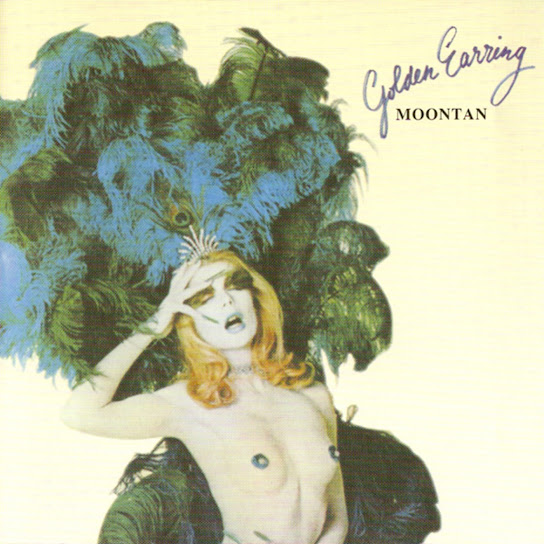
Radar Love remains an enduring 'car classic' and radio anthem of global fame to this day. Between 1969 and 1985 Golden Earring completed ten major tours of North America, building a considerable North American fanbase, as well as five headlining tours of Great Britain in 1973 and 1974 alone. Golden Earring toured as 'special guests' of The Who, Aerosmith, Led Zeppelin, .38 Special, Rush and many more, whereas bands like Aerosmith, KISS, ZZ Top and Lynyrd Skynyrd opened for Golden Earring. The album that spawned Radar Love, 1973's Moontan, was certified 'Gold' by North America's RIAA in 1974 and sold millions of copies worldwide.
The band failed to achieve similar chart success in the years after Radar Love: the progressive Switch (1975) and To The Hilt (1976) charted in Billboard's album charts, but yielded no major U.S. hits.