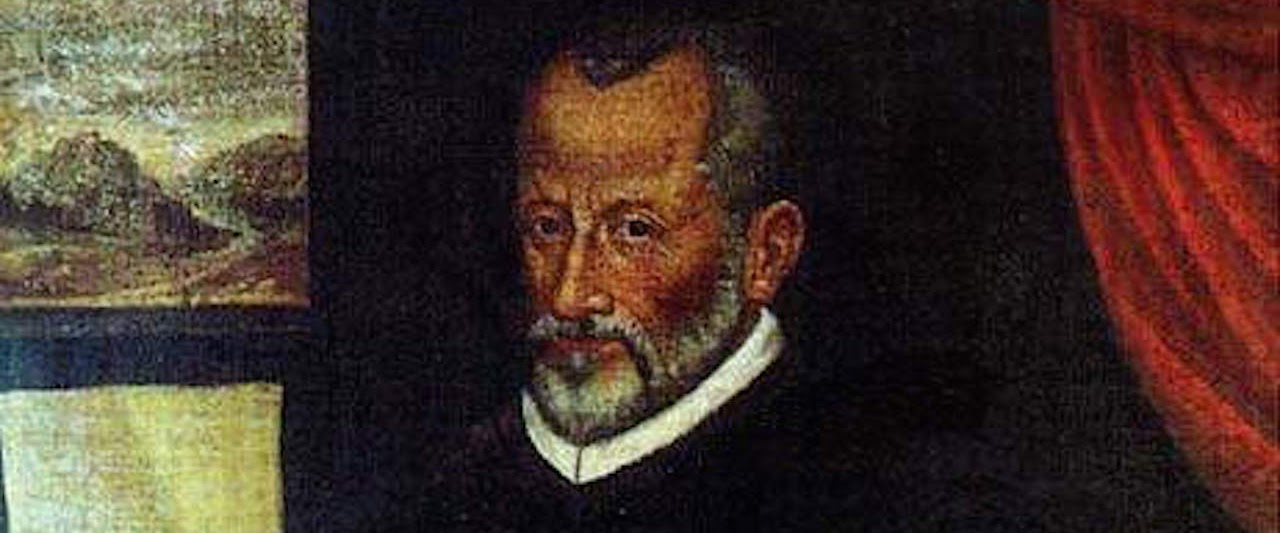
Giovanni Pierluigi da Palestrina (b. 3 February 1525 – 2 February 1526; d. 2 February 1594) was an Italian Renaissance composer and the most well-known 16th-century representative of the Roman School of musical composition. Palestrina became famous through his output of sacred music. He had an enormous influence on the development of Roman Catholic church music, and his work has often been seen as the culmination of Renaissance polyphony. It is only recently, with the discovery and publication of a great deal of hitherto unknown or forgotten music by various Renaissance composers, that we have had the means to properly assess Palestrina in historical context.
Palestrina was born in Palestrina, a town near Rome, then part of the Papal States. He spent most of his career in Rome. Documents suggest that he first visited the city in 1537, when he is listed as a chorister at Santa Maria Maggiore basilica. He studied with Robin Mallapert and Firmin Lebel.
Palestrina came of age as a musician under the influence of the northern European style of polyphony, which owed its dominance in Italy primarily to two extraordinarily successful Franco-Flemish composers, Guillaume Dufay and Josquin des Prez, who had spent significant portions of their careers there. Italy itself had yet to produce anyone of comparable fame or skill in polyphony.
From 1544 to 1551, Palestrina was organist of the principal church (St. Agapito) of his native city, and in 1551 he became maestro di cappella at the Cappella Giulia, the papal choir at St. Peter's Basilica. His first published compositions, a book of masses, had made so favorable an impression with Pope Julius III (previously the Bishop of Palestrina) that he appointed Palestrina musical director of the Julian Chapel. This was the first book of masses by a native composer: in the Italian states of his day, most composers of sacred music were from the Low Countries, France, Portugal, or Spain. In fact the book was modeled on one by Cristóbal de Morales: the woodcut in the front is almost an exact copy of the one from the book by the Spanish composer.
During the next decade, Palestrina held positions similar to his Julian Chapel appointment at other chapels and churches in Rome, notably St John Lateran, (1555–1560 - a post previously held by Lassus) and St Maria Maggiore (1561–1566). In 1571 he returned to the Julian Chapel and remained at St Peter's for the rest of his life. The decade of the 1570s was difficult for him personally: he lost his brother, two of his sons, and his wife in three separate outbreaks of the plague (1572, 1575, and 1580, respectively). He seems to have considered becoming a priest at this time, but instead he remarried, this time to a wealthy widow. This finally gave him financial independence (he was not well paid as choirmaster) and he was able to compose prolifically until his death. Palestrina spent the remainder of his life, from 1551 onward, in Rome.
He died in Rome of pleurisy in 1594. In keeping with the custom of that time, Palestrina was buried on the same day he died, in a plain coffin with a lead plate on which was inscribed "Joannes Petrus Aloyius Praenstinus Musicae Princeps." His own setting of Libera me Domine, a five-part psalm for three choirs, was sung at the funeral. In the same year on February 14th, a requiem mass in his memory was sung in the chapel of S. Maria del Soccorso.
Palestrina left hundreds of compositions, including 105 masses, 68 offertories, and more than 300 motets. In addition, there are at least 72 hymns, 35 magnificats, 11 litanies, and four or five sets of lamentations. He also composed at least 140 madrigals. His attitude toward madrigals was somewhat enigmatic: whereas in the preface to his collection of Canticum canticorum (Song of Songs) motets (1584) he renounced the setting of profane texts, only two years later he was back in print with Book II of his secular madrigals (some of these being among the finest compositions in the medium). He published just two collections of madrigals with profane texts, one in 1555 and another in 1586. The other two collections were spiritual madrigals, a genre beloved by the proponents of the Counter-Reformation.
There are two comprehensive editions of Palestrina's works: one edited by Haberl and published in 33 volumes in 1862-94, the other edited by R. Casimiri and others and published in 34 volumes.
Palestrina's masses best show us how his compositional style developed over time. His Missa sine nomine seems to have been particularly attractive to Johann Sebastian Bach, who studied and performed it while writing the Mass in B minor. Most of Palestrina's masses appeared in thirteen volumes printed between 1554 and 1601, the last seven published after his death.
One of his most enduring masterpieces is the Missa Papae Marcelli (Pope Marcellus Mass), which according to legend was composed in order to persuade the Council of Trent that a draconian ban on the polyphonic treatme