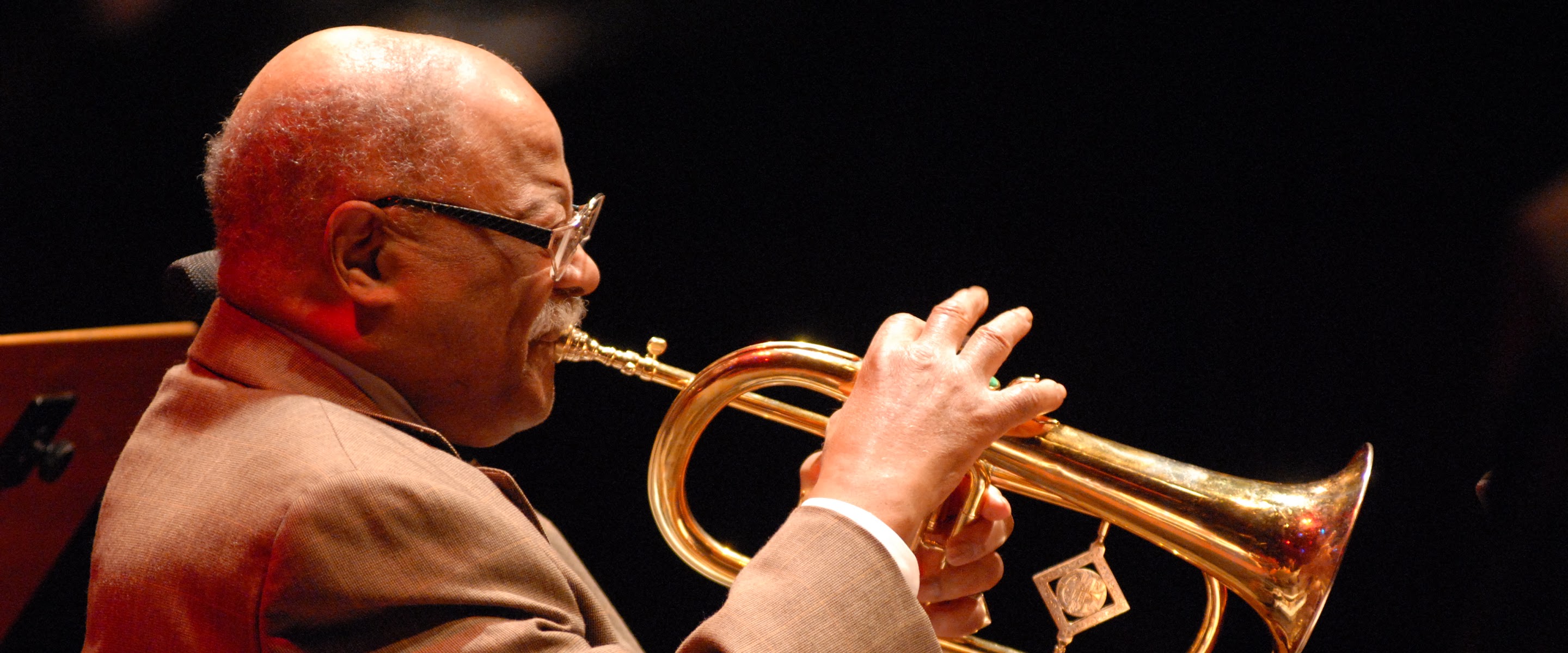
Clark Terry (December 14, 1920 – February 21, 2015) was an American swing and bebop trumpeter, a pioneer of the flugelhorn in jazz, educator, and NEA Jazz Masters inductee.
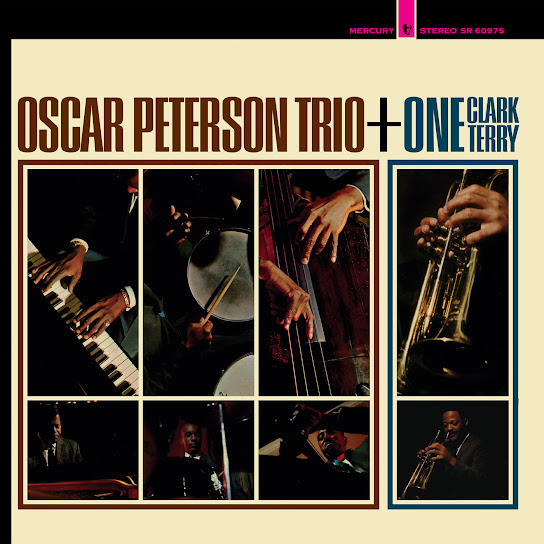
He played with Charlie Barnet (1947), Count Basie (1948–1951), Duke Ellington (1951–1959), Quincy Jones (1960), and Oscar Peterson (1964-1996). He also appeared on record with Louis Armstrong, Thelonious Monk, Charles Mingus, Ray Charles, Ella Fitzgerald, Billie Holiday, and Dizzy Gillespie. Over a seven decade career Terry mentored world-class talents such as Quincy Jones, Miles Davis, Herbie Hancock, Wynton Marsalis, Dianne Reeves, Terri Lyne Carrington, Arturo Sandoval and Justin Kauflin. He considered one of the most recorded jazz artists of all time, and appears on over 900 recordings.
Contents
Terry was born in St. Louis, Missouri, in 1920. He attended Vashon High School and began his professional career in the early 1940s, playing in local clubs. He served as a bandsman in the United States Navy during World War II.
Blending the St. Louis tone with contemporary styles, Terry's years with Basie and Ellington in the late 1940s and 1950s established his prominence. During his period with Ellington, he took part in many of the composer's suites and acquired a reputation for his wide range of styles (from swing to hard bop), technical proficiency, and good humor. Terry influenced musicians including Miles Davis and Quincy Jones, both of whom acknowledged Terry's influence during the early stages of their careers. Terry had informally taught Davis while they were still in St Louis.
After leaving Ellington, Clark's international recognition soared when he accepted an offer from the National Broadcasting Company (NBC) to become its first African-American staff musician. He appeared for ten years on The Tonight Show as a member of the Tonight Show Band, first led by Skitch Henderson and later by Doc Severinsen, where his unique "mumbling" scat singing led to a hit with "Mumbles". In the 1980s he was a featured soloist performing in front of the band. In November 1980 he was a headliner along with Anita O'Day, Lionel Hampton and Ramsey Lewis during the opening two-week ceremony performances celebrating the short-lived resurgence of the Blue Note Lounge at the Marriott O'Hare Hotel near Chicago. He was introduced to great acclaim by Chicago jazz disc-jockey Dick Buckley.
Terry continued to play with musicians such as trombonist J. J. Johnson and pianist Oscar Peterson, and led a group with valve-trombobist Bob Brookmeyer that achieved some success in the early 1960s. In February 1965 Brookmeyer and Terry appeared on BBC2's Jazz 625. In the 1970s, Terry concentrated increasingly on the flugelhorn, which he plays with a full, ringing tone. In addition to his studio work and teaching at jazz workshops, Terry toured regularly in the 1980s with small groups (including Peterson's) and performed as the leader of his Big B-A-D Band (formed about 1970). After financial difficulties forced him to break up the Big B-A-D Band, he performed with bands such as the Unifour Jazz Ensemble. His humor and command of jazz trumpet styles are apparent in his "dialogues" with himself, on different instruments or on the same instrument, muted and unmuted. He occasionally performed solos on a trumpet or flugelhorn mouthpiece.
From the 1970s through the 1990s, Terry performed at Carnegie Hall, Town Hall, and Lincoln Center, toured with the Newport Jazz All Stars and Jazz at the Philharmonic, and was featured with Skitch Henderson's New York Pops Orchestra. In 1998, Terry recorded George Gershwin's "Let's Call the Whole Thing Off" for the Red Hot Organization's compilation album Red Hot + Rhapsody, a tribute to George Gershwin, which raised money for various charities devoted to increasing AIDS awareness and fighting the disease. In 2001, he again recorded for the Red Hot Organization with artist Amel Larrieux for the compilation album Red Hot + Indigo, a tribute to Ellington.
Prompted early in his career by Dr. Billy Taylor, Clark and Milt Hinton bought instruments for and gave instruction to young hopefuls, which planted the seed that became Jazz Mobile in Harlem. This venture tugged at Terry's greatest love: involving youth in the perpetuation of jazz. From 2000 on, he hosted Clark Terry Jazz Festivals on land and sea, held his own jazz camps, and appeared in more than fifty jazz festivals on six continents. Terry composed more than two hundred jazz songs and performed for seven U.S. Presidents.
He also has several recordings with major groups including the London Symphony Orchestra, the Dutch Metropole Orchestra, and the Chicago Jazz Orchestra, hundreds of high school and college ensembles, his own duos, trios, quartets, quintets, sextets, octets, and two big bands: Clark Terry's Big Bad Band and Clark Terry's Young Titans of Jazz. The Clark Terry Archive at William Paterson University in Wayne, New Jersey, contains instruments, tour posters, awards, ori