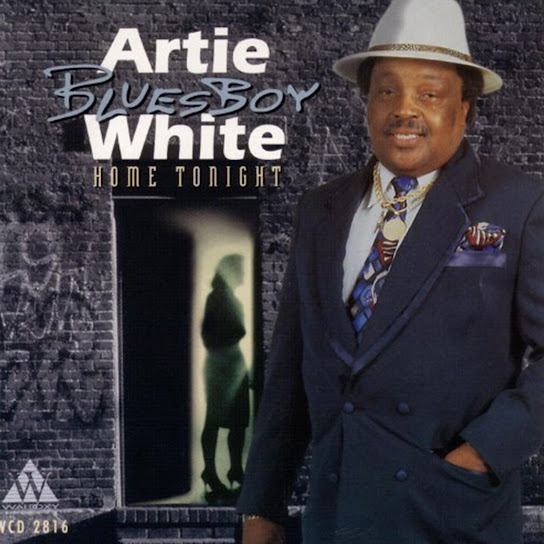
Artie “Blues Boy” White—an important figure in contemporary blues and one of the artists who helped bridge the gap between the blues of the postwar era and the contemporary hybrid “soul-blues” style—passed away on Saturday, April 20, 2013, four days after his 76th birthday.
White was born on April 16, 1937, either in or near the city of Vicksburg, Miss. He sang gospel as a youth, and after moving to Chicago in the mid-1950s, he worked with such local gospel groups as the Full Gospel Wonders and the Sensational True Lights (out of Hopewell Baptist Church at 65th and Cottage Grove). But by the time he began to record in about 1968, he’d crossed over into secular music. His first significant record was “(You Are My) Leanin’ Tree” by Chicago songwriter Bob Jones, issued on the AlTee label in 1977. It peaked at number 99 on the national R&B charts. Although he never had another chart single, he recorded and toured consistently until health problems finally slowed him down. A few of his albums made the national R&B charts; some of his singles (“I’m Gonna Marry My Mother-In-Law” in 1994; “Your Man Is Home Tonight” from 1997) became popular along the southern soul-blues circuit. In the early 2000s, he launched his own label, Achilltown. This wasn’t the first time he showed an entrepreneurial flair: Back in the ’70s, he became the proprietor of Bootsy’s Show Lounge at 2335 S. Cottage Grove. In the mid-‘80s, he opened its successor, the New Club Bootsy’s, at 55th and State and it remained in operation until the early 1990s.
At least in Chicago, White will be remembered for his outsized personality as much as for his music. He was almost much a fixture in the audiences at blues shows around Chicago as he was onstage. Whenever a big-name blues revue rolled into town to appear at East of the Ryan on 79th Street, or at Mr. G’s Supper Club on 87th, you’d probably find Artie there, sitting at the bar or standing in a corner with a group of friends, surveying the scene through heavy-lidded eyes. When the inevitable recognition came from the stage—“Ladies and gentlemen, we have Artie ‘Blues Boy’ White in the house tonight!”—he’d break into a smile and acknowledge the applause with a brief wave of offhand, almost regal ease. In his demeanor and his conversation, he seemed to epitomize the prototypical big-city blues hipster: affectionate but gruff, a bit profane, signifying and carrying on with his running buddies, a man among men.
His stage act accentuated this image. He sported gold chains and stood loose-limbed at the microphone with a casualness bordering on arrogance, engaging his audience in ribald repartee; his grainy baritone croon was shot through with sinewy machismo. The lyric content of his songs often seemed to confirm his image as a seasoned player, gritty and street-tough, wounded by love but still cocky and ready to let the good times roll.
The side White chose to reveal to me when we spent an afternoon talking in a quiet corner of Chicago’s Checkerboard Lounge early in the spring of 2002, however, was markedly different. As he nursed a non-alcoholic beer and stared pensively across the room, he spoke with gentle but firm conviction about his religious faith, his pride in having weaned himself from both tobacco and alcohol, and his sorrow over the ravages that casino gambling and other vices have visited on neighborhoods and families from Mississippi to Chicago. It was this ability to balance his public bluesman’s persona with his private identity as a serious-minded man who valued faith and family that I’ll remember as Artie’s most enduring, and endearing, personal legacy. “The Bible tell you only the strong will survive,” he told me. “The weak ain’t gon’ make it. You have to be strong at whatever you gonna do. The Lord ain’t gon’ send you out there by yourself. He always say, ‘You make one step, I’ll make two.’”
As it turned out, White was going to need all the spiritual resilience he could summon to endure the trials that awaited him. Wracked by multiple health crises as the new millennium progressed, he became virtually incapacitated, eventually confined to a wheelchair. For a while, he continued to make it to various shows around town, where he’d hold court backstage with as much energy and responsiveness as he could muster; eventually, though, even this became impossible. For the last several years of his life, he lived in virtual seclusion with his wife, Bettie, whose courage, determination, and unbending faith in tending and caring for him—virtually 24 hours a day, often even when he was in the hospital—was inspiring and humbling to all who witnessed it. His death, as tragic as it was, was not unexpected. Privately, many of his closest associates breathed a sigh of relief, even as they mourned him and rallied around Bettie to provide support.
On Friday, April 26, a celebration of White’s life was held at Gatlings Funeral Home Technically, the room was a chapel, but for this one time, as emcee/hos