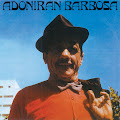
Adoniran Barbosa, artistic name of João Rubinato (6 August 1910 – 23 November 1982), was a noted Brazilian São Paulo style samba singer, composer and also a comedian and actor.
Rubinato represented several characters on radio programs, including Adoniran Barbosa, who ended up being confused with his creator due to his great popularity. Adoniran became nationally known as the father of samba made in São Paulo.
Early Years
João Rubinato was the seventh child of Francesco (Fernando) Rubinato and Emma Ricchini, Italian immigrants from Cavarzere (province of Venice). His parents had settled in Valinhos, a rural town in the state of São Paulo, about 70 km from the city of São Paulo. In 2010, two bridges were named after Rubinato: one located in Valinhos, Brazil, where the singer was born, and another in Cavarzere, Italy.
He is said to have been a rather reluctant student, and started working at an early age (which required falsifying his birth date). His first job was a sweeper boy and general helper at a railway company in the nearby town of Jundiaí. In 1924 he moved to Santo André, a town in the Greater São Paulo area, where he went through many jobs — loom operator, painter, plumber, iron worker, peddler and waiter. At a local technical school (the Liceu de Artes e Ofícios) he learned the office of mechanical assistant.
Debut as composer and singer
In 1933 João Rubinato moved to the city of São Paulo, where he started composing songs and tried his luck as a singer in Cruzeiro do Sul radio station, in a talent-scouting show directed by Jorge Amaral. After many failures, he finally succeeded with the Noel Rosa’s samba “Filosofia”, and got a contract for a weekly 15-minute show.
Fearful that a samba artist with an Italian surname would not be taken seriously by the public, João Rubinato then decided to adopt a more Brazilian-sounding name. So he borrowed the unusual "Adoniran" from one of his friends, and "Barbosa" from samba composer Luiz Barbosa, his idol.
In 1935 he won a Carnaval song contest sponsored by the city of São Paulo, with the samba Dona Boa, composed together with J. Aimberê. Spirited by that success, he married his longtime girlfriend Olga. The couple had a daughter, Maria Helena, but the marriage broke up in less than one year.
At “Radio Record”
In 1941 he started performing comedy in the radio theater programs of the São Paulo radio station Rádio Record, — which would later become one of the top television and radio networks of Brazil — Rede Record. He remained with that network until his retirement in 1972; giving his voice to various popular characters created together with writer Osvaldo Moles, like: Pernafina, Zé Cunversa, and Jean Rubinet (a parody of a French movie star). He also played parts in the movies: Pif-Paf (1945) and Caídos do Céu ("Fallen from Heaven") (1946), both directed by Ademar Gonzaga. In 1949 he married Matilde de Lutiis, who would be his companion and co-author for the next 50 years.
Success
His first success as a composer became a well-known song on samba circles, in concert halls: "Trem das Onze". It is quite possible that every Brazilian knows, if not the entire song, at least the chorus, which became timeless and a Brazilian classic. With this song Adoniran achieves the desired success, which, however, is short-lived and does not earn him more than a few changes in copyright. The song, which had already been recorded by the author in 1951 and had yet to be a hit, is re-recorded by Demônios da Garoa, or “Drizzle Devils” - a musical group from São Paulo, a city known as the land of drizzle, of fog, hence the groups’s name. Although the group is from São Paulo, the song first becomes a hit in Rio de Janeiro, with resounding success.
Astute observer of human activities, he also knows that the public is not content with just the drama of destitute and lonely people; it is necessary to give this audience a dose of humor, even if bitter. He composes one of his most notable sambas for this audience, one of the first in which he worked on the new aesthetics of samba.
In 1953 he made a fine performance in the movie O Cangaceiro, by director Lima Barreto. In the early 1950s he wrote many songs on typical São Paulo themes, most of them recorded by the band Demônios da Garoa, and won two other São Paulo Carnaval contests. In 1955 he introduced the enormously popular character Charutinho ("Short Cigar") in the radio humor show Histórias das Malocas ("Shantytown Stories").
Adoniran also acted in some of the earliest Brazilian soap operas (telenovelas), such as A Pensão de D. Isaura ("Ms. Isaura's Boarding Home"), and comic programs like Ceará contra 007 ("Ceará against 007") and Papai Sabe Nada ("Daddy Knows Nothing").
Later years and legacy
In spite of the success of his songs and radio characters, Adoniran only became a star of sorts after 1973 when he recorded his first own album. That made him respected as a major composer, and gave him some media exposure. Nev