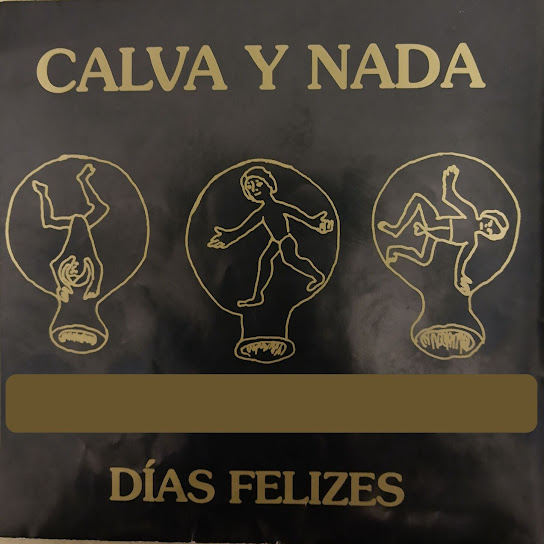
Calva y Nada was one of the most innovative groups of the German Electro Dark Wave from the beginning of the 90's, when a rebirth of the electro-dark music took place. The group had a great impact when it first appeared and kept the impact as it continued, maintaining the unalterable and original style from their first album "Días Felizes" (1991) until their most recent release, "Schlaf" (1998).
In 1990, after abandoning Glatze des Willens and starting his career alone under the name Calva y Nada, Breñal released his first LP named "El Peste Perverso LLeva Mi Peluca" on the label ZZO Records. Some critics considered the album too experimental, although the music in it has already the deep essence of Calva y Nada’s peculiar style. Lyrically, the album is inspired by the writings of a Calvinist secret correspondent in the hypercatolic Spain of the 16th century. The songs on that album have a sour, dry, serious and rude timber a lot of people have tried to relate to D.A.F. or even Laibach.
After the release of their next album through the label Hyperium, "Días Felizes" (CD, LP), in 1991, Calva y Nada became pretty well known in the German electro scene, which in the beginning of the 90´s experienced an incredible peak that gave place to formations of different styles such as And One, Armageddon Dildos and Das Ich. The album is a quite direct, even dancing sometimes, with lyrics both in German and Spanish and a special treatment for the rhymes, conferring to the interpretations a colder and more metallic tone. It offered pure and raw techno, conquering the admiration of many with its originality. Calva y Nada was one of the few bands at the time which didn't fall in the easy road of EBM, as it kept practicing a more analogical sound, with freer outlines, out of the ingenious-sounding typical sequences, presenting dark, dramatic, mystical, overwhelming and captivating orchestrations. "I wouldn't be able to create a song of five minutes saying Move, Move, Move your Body; my lyrical aspirations go farther than that" Breñal says.
The sequences flowed clean, working as base for the resentful, melancholic and uncompromising echoes of the vocals. The structures were unique since they were broken in variations of tonalities, which digressed in true meditations without losing the thread of the song.
In 1993, Calva y Nada conquered many new followers thanks to the marketing campaign of Hyperium for their new album "Monologe Eines Baumes", which sounds like a mixture of the previous ones; it's about the symbolic sentimental life of a tree, since when it was born until the day it finishes as a table or another piece of furniture. It is more a history than an analogy or personification. By taking a look to the lyrics, one can find many mystic and pseudo-psychological symbols. "Obviously, I am a pupil of my own philosophy.... but the most important thing is the music. The Calvinism, Catholicism, Humanism, they are all simple «Isms» that can be mingled, but they are not opposed to my own philosophy and my form of seeing the music. I try to disclose a collective-individualism, which means that each individual should believe in his own perspective, that they should simply look for their own road. I am also a very religious person, but not in the classical sense. I follow the steps of my own religion, with which I didn't have any problem until the present moment".
As a work done in the first three months of 1994, the EP "Die Katze Im Sack" was released. It constitutes a work apart, because it was never supposed to be an advance for the following album. The EP contains very peculiar songs like "Borriquito" (a previously unreleased version of the song), new mixes for "Días Felizes" and "Der Stum" (tracks from previous albums), the infantile song "Fern von den Engeln", and finally the song "Palpita, Corazón, Palpita", which with no doubt is the most elaborated and mature work by Breñal...
The songs kept the strongly orchestrated arrangements, supported by a martial and semi-dancing rhythm; but this time they were mixed with pretty unusual harmonic sequences. Thanks to this contrast the unusual aspect of the music becomes much more evident and can be assimilated more easily. "In some songs I have used certain structures which are somehow ordinary, something very atypical for Calva y Nada. An example is the first song of the album for which I have used very soft vocals, it took me quite a lot of time to find the appropriate sounds".
The vocals possess certain theatrical characteristic while in the background one can hear organ chords ending up in bell sounds, leading to a furious "grand finale". The track "Disgust" begins with a monotonous piano melody which sails in a more and more chaotic sea, getting similar to an industrial tempest full of foamy and wobbly drums, preceding the appearance of a surrealist cloud, once more accompanied by a blurred piano sound. "I don't consider myself properly a musician